Mexican Red Rump (Tliltocatl vagans)
Last updated: May 8, 2026
This is not a care guide. If you are interested in keeping this species, please research its husbandry thoroughly before purchasing. Tom's Big Spiders has species-specific husbandry notes that are a solid place to start.
Tliltocatl vagans, the Mexican Red Rump, is one of the more visually striking terrestrial tarantulas you will find regularly available in the hobby. The contrast is simple but effective: a deep velvet-black body with a rich red or burgundy abdomen. It is not a subtle spider. When the abdomen is fully visible, it catches your eye immediately.
The species ranges across Mexico, Belize, Guatemala, and El Salvador; Honduran records should be verified depending on the source, making it one of the more widely distributed members of the Tliltocatl genus. It was formerly known as Brachypelma vagans before the genus revision in 2019, and you will still see the old name in some older listings and care guides.
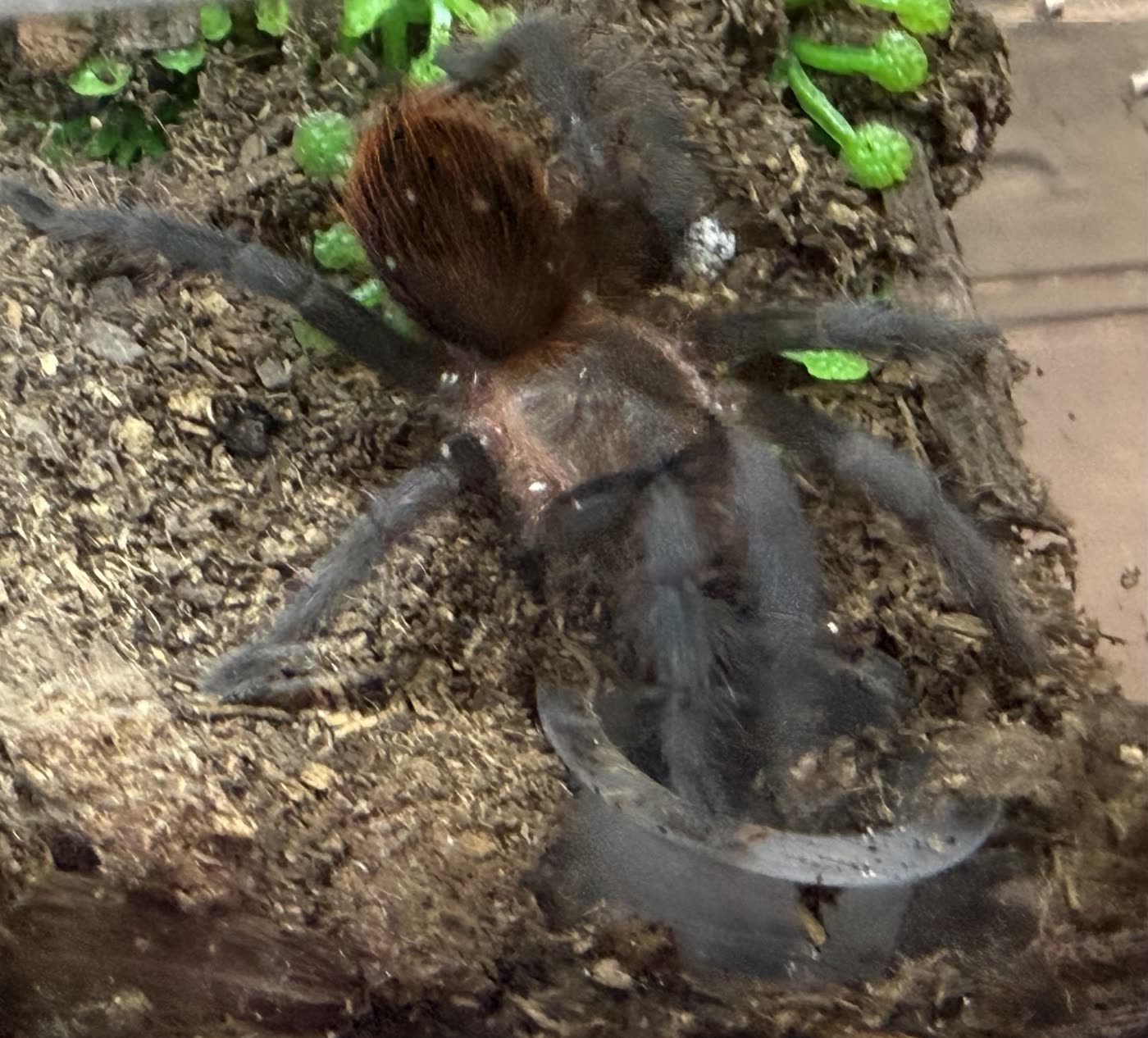
Compared to Other Beginner Terrestrials
If you are already familiar with T. albopilosus (the Curly Hair) or B. hamorii (the Mexican Red Knee), T. vagans sits somewhere in the middle in terms of temperament. It is generally calm and manageable, but it has a bit more attitude than a curly hair and tends to be slightly quicker to kick urticating hairs when it feels disturbed. It is not a defensive nightmare by any stretch, but it is worth knowing that it is not quite as placid as the Curly Hair either.
On the other hand, it grows noticeably faster than slow-growing genera like Brachypelma, Grammostola, and Aphonopelma, which makes the experience feel more dynamic if slow growers frustrate you. Females reach around 5 to 5.5 inches in legspan.
The Urticating Hair Thing
Like all new world tarantulas in this group, T. vagans has urticating hairs on its abdomen and will kick them when it feels threatened. Some individuals are more trigger-happy about this than others. Over time, the abdomen can look a little bald from repeated kicking, which is normal and grows back after molts. If you are sensitive to urticating hairs, keep that in mind when choosing where to place the enclosure.
Is This a Good Fit for You?
If you want a visually distinctive new world terrestrial that is a small step up from the most docile beginner species, T. vagans is a genuinely good choice. It is hardy, eats well, grows at a satisfying pace, and looks unlike most other commonly kept tarantulas. The red abdomen is the kind of thing that makes people do a double-take when they see it for the first time.
For newer keepers, it is manageable but worth being honest that it is slightly more reactive than a curly hair or a rose hair. If this would be your first tarantula, it is not a bad choice as long as you go in knowing what to expect. If you have kept a species or two already and want something that looks more dramatic without jumping into old world territory, this is a natural next step.
For experienced keepers, it is simply a beautiful and reliable species that holds its own in any collection.
Current Prices
Tliltocatl vagans (Mexican Red Rump) currently sells for between $8.00 and $200.00 in the United States, with a median asking price of $40.00 across 14 in-stock listings from 9 vendors. Price depends mostly on size and sex: slings sit at the low end, mature females at the high end.
| Cheapest listing right now | $8.00 |
|---|---|
| Typical price (median) | $40.00 |
| Most expensive listing | $200.00 |
| Listings in stock | 14 |
| Vendors carrying it | 9 |
In stock at: Big Z's, Buddha Bugs, Great Basin Serpentarium, Juice's Arthropods, Micro Wilderness, Pacific Northwest Arachnids, Spider Shoppe, Vexotic Me, Wonderland Exotics. Compare every Tliltocatl vagans listing by price.
Prices as of October 14, 2026. Live figures in the table below.
FAQs
Is Tliltocatl vagans good for beginners?
It can be a reasonable first tarantula for someone who has done their research. It is calmer than most old world species and its defensive behavior is primarily urticating hair kicks rather than biting. That said, it is slightly more reactive than the most commonly recommended beginner species like the Curly Hair, so it is worth being aware of that going in rather than expecting exactly the same experience.
Is this the same as Brachypelma vagans?
Yes. The genus was revised in 2019 and the species was moved from Brachypelma to Tliltocatl along with several other Mexican and Central American terrestrials. The old name still appears in many listings and older care resources.
Why does my T. vagans have a bald spot on its abdomen?
That is from kicking urticating hairs, which is the species' primary defensive behavior. It is completely normal and not a sign of illness. The setae grow back after the next molt. Some individuals kick more readily than others, so the bald patch may vary significantly from spider to spider.
How fast does Tliltocatl vagans grow?
Faster than many slow-growing new world genera, which is one of the things keepers appreciate about it. With regular feeding, juveniles grow noticeably between molts. It will not grow as fast as some of the more enthusiastic feeders in the hobby, but it is a satisfying grower compared to the very slow-growing genera like Aphonopelma or Brachypelma.