OBT / Orange Baboon Tarantula (Pterinochilus murinus)
Last updated: May 8, 2026
This is not a care guide. If you are interested in keeping this species, please research its husbandry thoroughly before purchasing. Tom's Big Spiders has species-specific husbandry notes that are a solid place to start.
The OBT is one of the most talked-about tarantulas in the hobby, and for good reason. It is beautiful, interesting to keep, and will remind you every single day that it is not a spider you can be casual around. If you want a display tarantula that stays on high alert and webs its enclosure into an elaborate fortress, this is your spider. If you want something mellow to observe at the end of the day, look elsewhere.
Pterinochilus murinus is native to East and Southern Africa, ranging across parts of eastern and southern Africa, including Tanzania, Mozambique, Zimbabwe, and South Africa. In the hobby it goes by several names: Orange Baboon Tarantula, OBT, or the affectionate "Orange Bitey Thing," which tells you a lot about what experienced keepers think of handling one. Females reach around 5 to 6 inches in legspan and are long-lived.
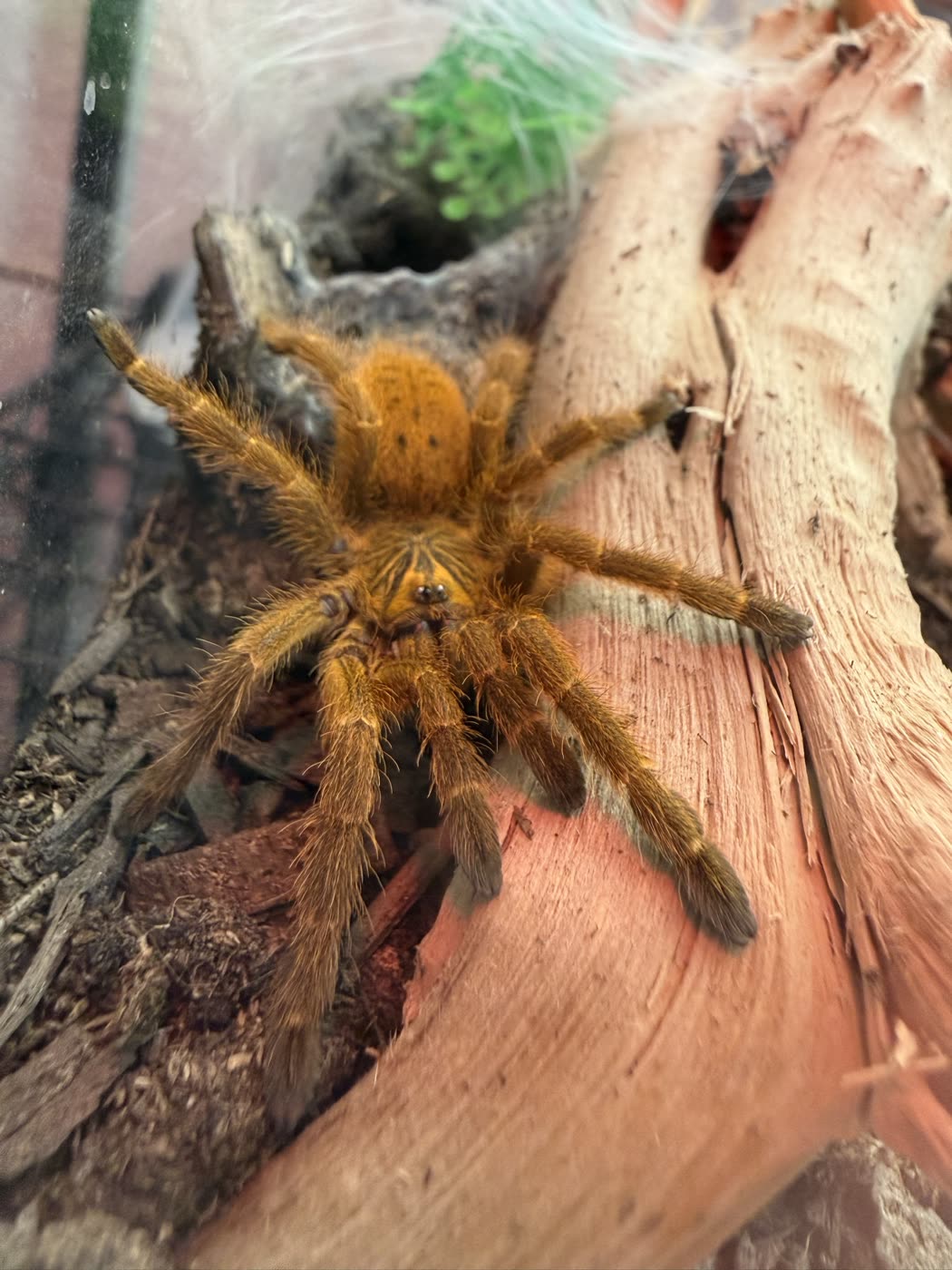
Locality Variants
This species is sold in several color forms and named locales. In the hobby, red or orange forms are often associated with the Usambara area, while darker forms are also widely available. Named locales such as Kigoma appear occasionally. The hobby shorthand RCF (Red Color Form) and DCF (Dark Color Form) are commonly used but do not map cleanly onto locality labels. It is worth looking at photos before you buy, since the coloring differences are significant.
One Thing to Know Upfront
This is an old world species, meaning it has no urticating hairs to kick at you. What it has instead is speed, a strong threat display, and venom considerably more significant than a typical new world tarantula. A bite from an OBT is not known to be life-threatening to healthy adults, but medically significant bites with severe pain, cramping, swelling, and systemic symptoms are reported. It should be taken seriously. The speed is real. This is not a species where slow, deliberate movements will always save you.
Is This a Good Fit for You?
If you have kept a few tarantulas and are looking for something more engaging, the OBT delivers. It webs heavily and creates intricate tunnel systems that are fascinating to observe. Adults are frequently out in the open, making it an excellent display species if you are comfortable with the fact that "on display" also means "ready to defend itself."
This is not a beginner spider. Not because it is impossible for a new keeper to manage, but because its speed and reactivity leave very little margin for error. The kind of casual mistake that is no big deal with a curly hair or a rose hair can become a real problem with a P. murinus. Get a year or two of experience first, feel comfortable with the basics of working around a defensive spider, and then come back to this one.
For keepers who are ready for it, the OBT is one of the most rewarding species in the hobby. It is hardy, long-lived, visually striking in several distinct forms, and endlessly interesting to observe. It has a strong following for good reasons.
Current Prices
Pterinochilus murinus (OBT / Orange Baboon Tarantula) currently sells for between $20.00 and $350.00 in the United States, with a median asking price of $40.00 across 35 in-stock listings from 18 vendors. Price depends mostly on size and sex: slings sit at the low end, mature females at the high end.
| Cheapest listing right now | $20.00 |
|---|---|
| Typical price (median) | $40.00 |
| Most expensive listing | $350.00 |
| Listings in stock | 35 |
| Vendors carrying it | 18 |
In stock at: Big Z's, Buddha Bugs, Cory's Creatures, FangzTV, Fear Not Tarantulas, Great Basin Serpentarium, Grimoire Exotics, Hardcore Arachnids, Juice's Arthropods, Marshall Arachnids, Micro Wilderness, Old Pueblo Exotics, Pacific Northwest Arachnids, Spider Shoppe, The Spider Room, Ty Dye Exotics, Vexotic Me, Wonderland Exotics. Compare every Pterinochilus murinus listing by price.
Prices as of October 14, 2026. Live figures in the table below.
FAQs
Is the OBT good for beginners?
Most experienced keepers would say no, and I'd agree. The speed and defensive nature leave little room for the kind of casual mistakes new keepers make. Once you have a year or two of experience under your belt and a sense of your own comfort level with reactive spiders, an OBT is a natural and very satisfying next step.
How defensive is Pterinochilus murinus, really?
Pretty defensive. Some individuals are more relaxed than others, but the species reputation is well-earned. You should assume that any interaction with the enclosure, including routine feeding and maintenance, may be met with a threat display or an attempt to bolt. Going in with that expectation makes the whole thing easier to manage.
What is the difference between the RCF and DCF?
RCF stands for Red Color Form and DCF for Dark Color Form. The RCF tends toward a warm orange-amber coloring while the DCF runs darker and more brownish-gray. Both are the same species with the same care requirements and the same temperament.
Does Pterinochilus murinus have urticating hairs?
No. Like all old world tarantulas, P. murinus does not have urticating setae. Its defense is entirely behavioral: speed, threat displays, and biting. This is one of the reasons you need to be more careful with old world species than with most new world tarantulas.