Mexican Fireleg (Brachypelma boehmei)
Last updated: May 13, 2026
This is not a care guide. If you are interested in keeping this species, please research its husbandry thoroughly before purchasing. Tom's Big Spiders has species-specific husbandry notes that are a solid place to start.
Brachypelma boehmei is one of the most striking-looking tarantulas you can buy. Its legs are a deep, vivid orange that borders on red, set against a dark black body. Most specimens have an orange carapace, or at least a carapace that is predominantly orange, though some individual variation exists. Where the Mexican red knee is iconic and universally recognizable, the fireleg has coloring that is arguably more dramatic. It is native to the Guerrero state of Mexico, living in dry tropical forest and scrubland at elevation.
Like all Brachypelma, it is protected under CITES Appendix II, which restricts trade in wild-caught specimens. Most animals sold through reputable hobby vendors are captive bred, but the listing does not guarantee that every specimen in circulation is — verify origin with whoever you are buying from.
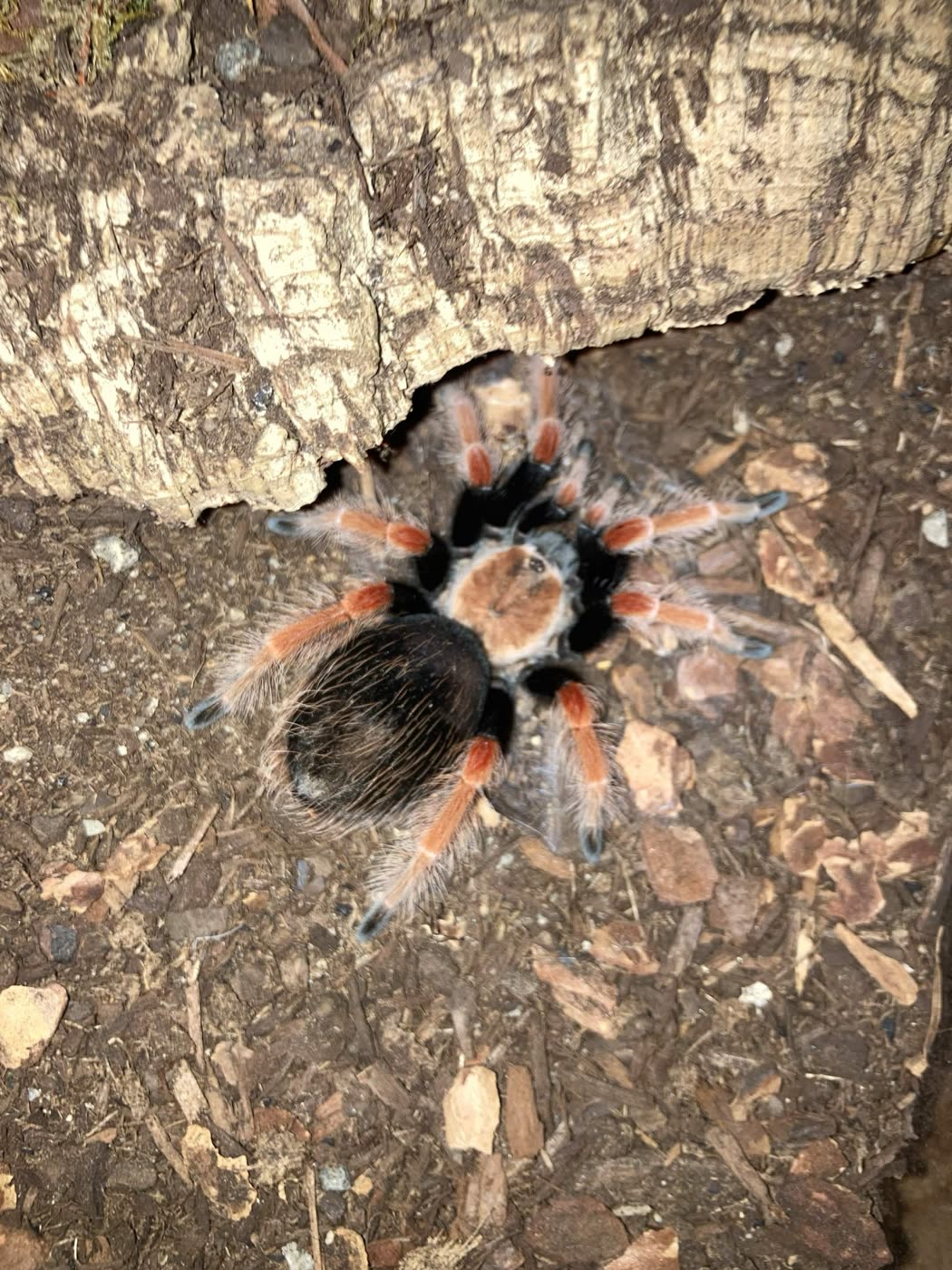
Compared to the Mexican Red Knee
The fireleg and the red knee are the two Brachypelma species most commonly available in the hobby, and they get compared constantly. The temperament is broadly similar: both are new world terrestrials with a generally calm disposition and the typical new world defense of urticating hair flicking. The fireleg does tend to be a bit more flighty and less predictable during enclosure work than the red knee. It is not a dramatic difference, but it is enough that keepers who have handled both tend to notice it.
Coloring is the main reason to choose between them. The red knee has the iconic orange-banded knees on a dark body. The fireleg has full orange-to-red legs with a deep black contrast. Both are beautiful in different ways and many keepers own both eventually.
The fireleg grows slowly, like all Brachypelma. Females can live 20 or more years, and reaching full adult size takes several years. This is a species where buying a young adult or sub-adult female rather than a sling is often the more practical choice unless you genuinely enjoy the long-term project of raising one from early on.
Is This a Good Fit for You?
The fireleg is a good fit if you already have experience with Brachypelma or other new world terrestrials and want something that is visually distinct. It is not quite as straightforward as the red knee in terms of temperament, but it is still a very manageable species for anyone who has kept a few tarantulas. Its looks justify the slightly more attentive maintenance.
If you are new to the hobby and want your first Brachypelma, starting with B. hamorii is a more forgiving introduction. Once you have that experience and want to add another Mexican species with even more striking coloring, the fireleg is a natural choice.
Current Prices
Brachypelma boehmei (Mexican Fireleg) currently sells for between $45.00 and $250.00 in the United States, with a median asking price of $72.50 across 14 in-stock listings from 10 vendors. Price depends mostly on size and sex: slings sit at the low end, mature females at the high end.
| Cheapest listing right now | $45.00 |
|---|---|
| Typical price (median) | $72.50 |
| Most expensive listing | $250.00 |
| Listings in stock | 14 |
| Vendors carrying it | 10 |
In stock at: ArachnoEden, Big Z's, Buddha Bugs, Cory's Creatures, Great Basin Serpentarium, Jamie's Tarantulas, Juice's Arthropods, Pacific Northwest Arachnids, The Spider Room, Vexotic Me. Compare every Brachypelma boehmei listing by price.
Prices as of October 14, 2026. Live figures in the table below.
FAQs
How does Brachypelma boehmei compare to Brachypelma hamorii?
Both are large, slow-growing, CITES-listed Mexican Brachypelma with broadly similar temperaments and care needs. The fireleg tends to be slightly more flighty during maintenance and has full vivid orange legs rather than the red knee's distinctive orange knee bands. The red knee is generally calmer and more reliably docile; the fireleg is a step up in visual drama and a small step up in unpredictability.
Is the Mexican Fireleg good for beginners?
It is suitable for keepers who have some experience. The slight additional flightiness compared to the red knee is not a serious challenge, but it is enough that starting with a more forgiving Brachypelma first makes the experience better for everyone. If you have kept a B. hamorii or similar species, the fireleg is a completely reasonable next step.
Why is Brachypelma boehmei CITES-listed?
All Brachypelma species are listed on CITES Appendix II due to historical overcollection from the wild. The listing means trade in wild-caught specimens is heavily restricted, and reputable hobby vendors sell captive-bred animals. That said, the listing does not mean every specimen in circulation is captive bred — origin documentation varies, and given the species' longevity, wild-caught specimens collected before stricter enforcement are still out there. Buy from reputable sources and ask about origin if it matters to you.
How long does the Mexican Fireleg live?
Females can live 20 years or more, consistent with other Brachypelma. Males have a substantially shorter lifespan and will mature much faster. This is a long-term commitment when you buy a female.