Fire Deals, Leaderboards, and Why I Don't Think Tarantulas Should Work Like Pokemon Cards
Last updated: July 31, 2026
TL;DR: A new site called FangTrack does something similar to Tarantula List, tracking prices across vendors. But it wraps that data in deal grades, "fire" badges, momentum stats, and a leaderboard that ranks people by the dollar value of their collection. I think that framing is a bad fit for something that eats, molts, and can outlive the person who bought it. Here's why, and how I built things differently.
Why I'm Writing This
I run Tarantula List. I've been tracking vendor prices and inventory across the hobby since 2025, mostly so buyers can compare listings and figure out who they can trust before they hand over their money. Someone recently pointed me to a new site, FangTrack, which launched sometime around the middle of 2026 and does a version of the same core thing: it pulls prices from a bunch of vendors and shows you what's out there.
I don't have a problem with someone else building a price tracker. It's not a wild idea, and there's room in this hobby for more than one tool. What I do want to talk about is a design choice FangTrack made that I think is worth bringing to your attention, because it shapes how people shop for something that's alive.
What FangTrack Actually Shows You
Open the FangTrack dashboard and the first things you see are stat blocks: Fire Deals, Exceptional, Strong, Fair, Above Market. Scroll down and there's a "Market Movers" panel with categories like "All-Time-Low Deals," "Heating Up," and "Rare Buys," each with little sparkline charts showing price trending up or down like a stock ticker. Species get percentage tags: +267%/mo, +236%/mo, numbers that are clearly meant to make you feel like you need to act before the window closes.
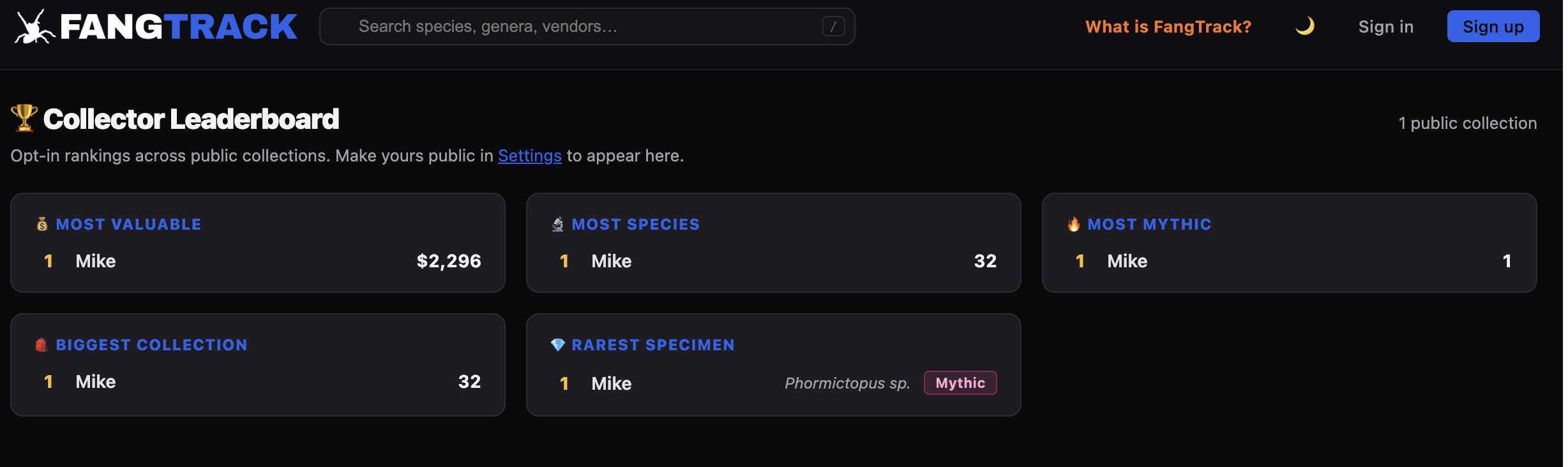
Then there's the "Collection" feature, which lets you upload what you own and see what it's "worth" at current market prices. And there's a Leaderboard, opt-in rankings across public collections, with categories like Most Valuable, Biggest Collection, and Rarest Specimen. As of when I checked, the leaderboard had exactly one public collection on it, belonging to the site's own founder, and the page took a noticeably long time to load.
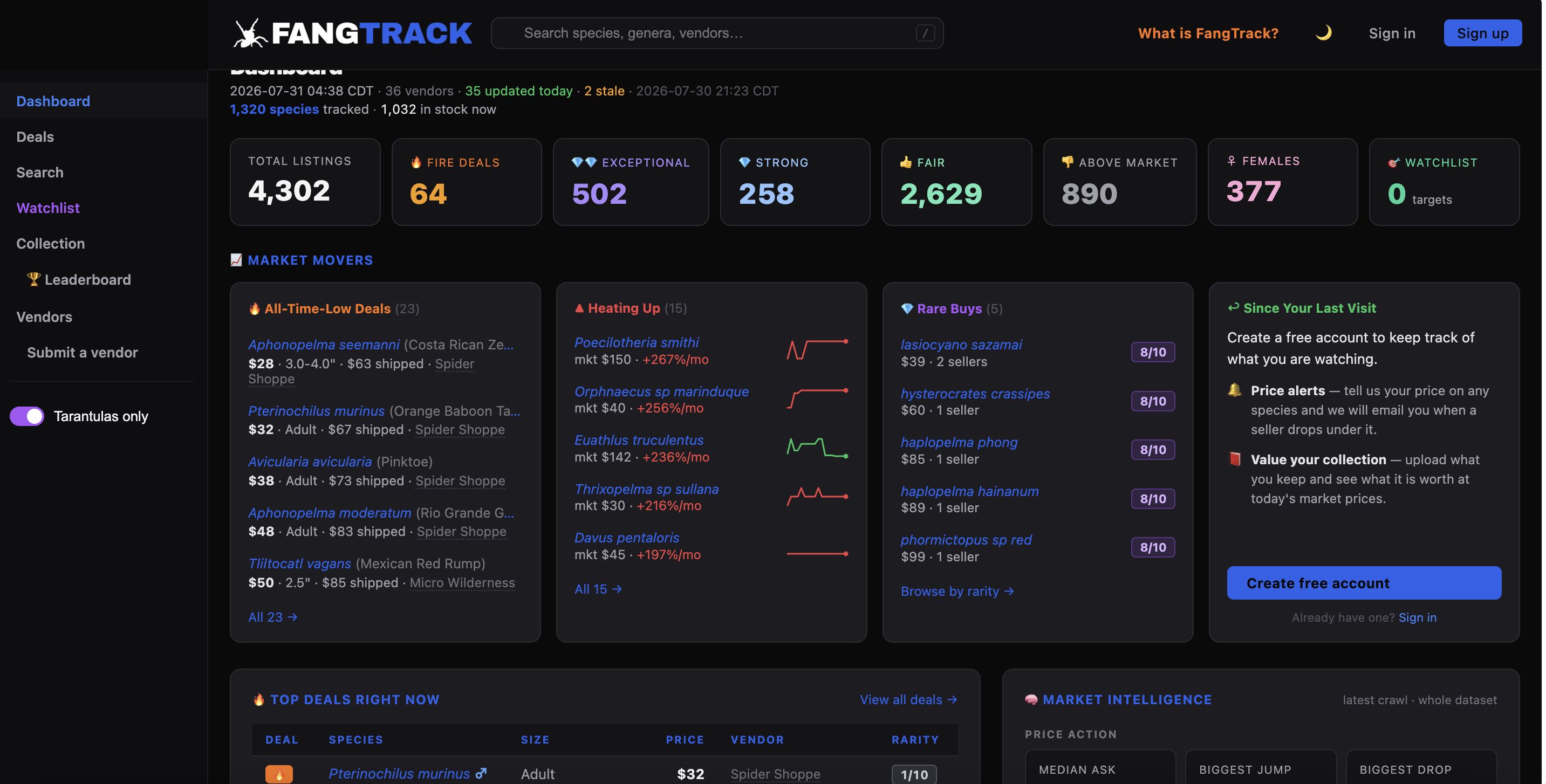
I want to be clear about what I'm criticizing here. It isn't the existence of price data. It's the layer on top of the price data, the part designed to make you feel like you're watching a market you need to jump into right now.
Why This Framing Doesn't Sit Right With Me
I wrote a while back about my own experience bidding in a Palmstreet auction, and how even though I got a good deal, the experience left me feeling like I wasn't really the one making the decision. Auctions do this on purpose. Countdown timers, competing bids, the fear of losing something you just decided you wanted thirty seconds ago. It works, and it works specifically by removing your ability to think.
FangTrack's dashboard borrows a lot of the same mechanics, just without the live auction clock. "Fire deals" and "heating up" tags are doing the same job a countdown timer does: they tell you this is a moment, not a decision you get to sit with. A percentage badge showing a species is up 267% this month isn't information you need to buy a healthy animal you can care for properly. It's a nudge to buy now, before the number goes higher.
And then there's valuing a collection. I get why this works as a feature. It's satisfying to see a number go up, the same way it's satisfying to see your Pokemon card binder appraised. But a tarantula isn't a card in a sleeve. It's a living animal with a lifespan, a temperament, specific enclosure and husbandry needs, and in the case of some species, twenty or more years ahead of it. Reducing that to a dollar figure and then ranking people by their total is a strange thing to gamify. It's the kind of framing that makes sense in collectible and reselling markets, where the thing being ranked really is just an object. It fits less well here.
How I Built Tarantula List Differently
None of this is theoretical for me, it's the same question I had to answer when I was building my own tools. My test has generally been whether a feature helps someone make a better decision or just makes the decision feel more exciting. A deal grade or a momentum percentage can be accurate and still mostly do the second thing. So the comparison tool just shows prices across vendors, plain, so you can compare and consolidate an order. No grades, no badges, nothing counting down.
That same thinking shaped how I handle vendors too. A seller has to meet a set of requirements I've laid out publicly before they're listed at all, and what matters most to me there is a clean history on Arachnoboards, verified transactions on MorphMarket if they've sold there, and no pattern of complaints, not how fast their inventory is moving. It's also why Keeper, the collection tracker I built as a companion app, never shows you a dollar total or ranks you against anyone else. It's there so you know what enclosures you have filled and what you're feeding on what schedule. That felt like a more useful question to answer than what your spiders are worth.
The Bottom Line
I don't think everyone who uses FangTrack is going to buy recklessly, and I don't think urgency-driven design is unique to that site. It's everywhere, from Palmstreet auctions to grocery store end caps. But when the product being sold is a living animal, I think it's worth naming the pattern instead of pretending it's just neutral market data. A price tracker can help you shop. It doesn't need a leaderboard to do that.
FAQs
Is FangTrack a scam?
I have no reason to think so. My criticism here is about the deal-hype framing and the collection leaderboard, not about whether the underlying price data is accurate or whether the site is trustworthy to use.
Is it wrong to want to know if I'm getting a good price?
Not at all. Knowing fair market value is exactly what a comparison tool should help with, it's why I built one. The issue isn't price transparency, it's stacking urgency cues like "heating up" and countdown-style momentum stats on top of that information.
Should I avoid tracking my collection's value entirely?
That's up to you. I just don't think it should be the headline feature, and I don't think it should be a public leaderboard. If you want to know what your animals are worth for insurance or resale reasons, that's reasonable. Turning it into a ranked competition is where I think it goes sideways.
Related Guides
- Tarantula Auctions and the Hobby: Thoughts From a (Reluctant) Bidder
- How to Choose the Right First Tarantula for You
- How I Order Tarantulas Online Using Tarantula List
Disclosures
I run Tarantula List and Keeper, so I'm obviously not a neutral party here. Screenshots referenced were taken from the public FangTrack dashboard and leaderboard pages in late July 2026.
If you use the comparison tool on the Tarantula List homepage, I may receive a small commission if you order through a vendor that supports us via a coupon code.